Below is an explanation and sources (where applicable) for information compiled on individual waterfall pages.
Waterway
The name of the stream where the waterfall is located.
Drainage Area
The area in which water drains into the waterfall. All data is from the United States Geological Survey (USGS) StreamStats application. A map of the drainage area is also provided.
Drainage Area Size
A general description of the size of a drainage area. Waterfalls with larger drainage areas typically have a higher volume of water flowing over and are more reliable during drier periods.
Height
The height of the waterfall in feet. Height data is generally from the New Jersey Geological and Water Survey through their “Natural Waterfalls of New Jersey” GIS data. They use a rangefinder device to determine accurate height data.
If the waterfall is not featured in this data, the height is estimated and features an “~” symbol.
Latitude and Longitude
The exact coordinates of the waterfall
Location
The municipality and county of the waterfall. All featured waterfalls are in New Jersey.
Type
The type of waterfall. Some waterfalls fall into multiple categories.
Punchbowl
A waterfall that descends into a large pool. An example is Van Campens Falls.
Plunge
A vertical waterfall that loses contact with the bedrock. New Jersey does not feature any Plunge Waterfalls.
Multi-step
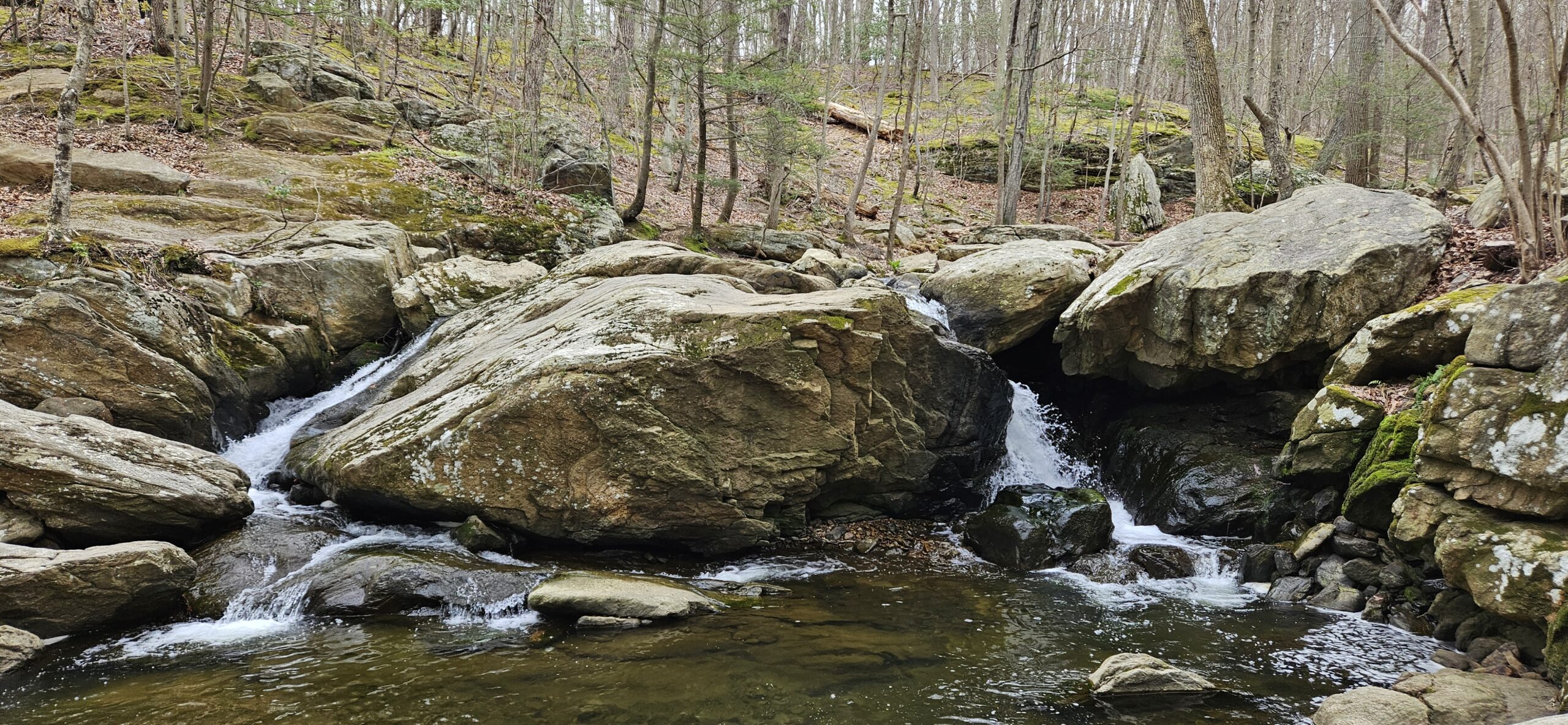
A waterfall featuring multiple drops separated by a pool of water. One of the most common types of waterfalls in New Jersey. Examples include Otter Hole Falls and Middle Laurel Falls.
Horsetail and Fantail
A waterfall that starts thin before widening out in the shape of a horse tail (or fan) while maintaining contact with the bedrock. Fantail Waterfalls extend further at the base than Horsetail Waterfalls. New Jersey does not have any true Horsetail Waterfalls, but does feature a few Fantail Waterfalls. Examples include Van Campens Falls and Chikahoki Falls
Chute
A generally powerful waterfall where water is forced through a narrow passage. Examples include Mine Hole Falls
Cataract
A large and powerful waterfall. An example is the Great Falls of the Passaic.
Cascade
A waterfall featuring many levels. The most common waterfall type in New Jersey. Examples include Van Campens Falls and Apshawa Falls.
Block
A large waterfall over a wide river. The only block waterfall in New Jersey is the Great Falls of the Passaic
Best Time to Visit
The time of year when the waterfall looks the best. This is typically during the spring due to high precipitation.
Property Type
Whether the waterfall is on public or private property. Generally, waterfalls on public property are open to the public to visit, although there are some exceptions, such as Mine Hole Falls.
Current Streamflow
A link to a hydrograph near the waterfall. A hydrograph measures the height and volume of water at a specific gauge. This is typically only available for waterfalls along major rivers such as the Great Falls of the Passaic or Boonton Falls.
Leave a Reply