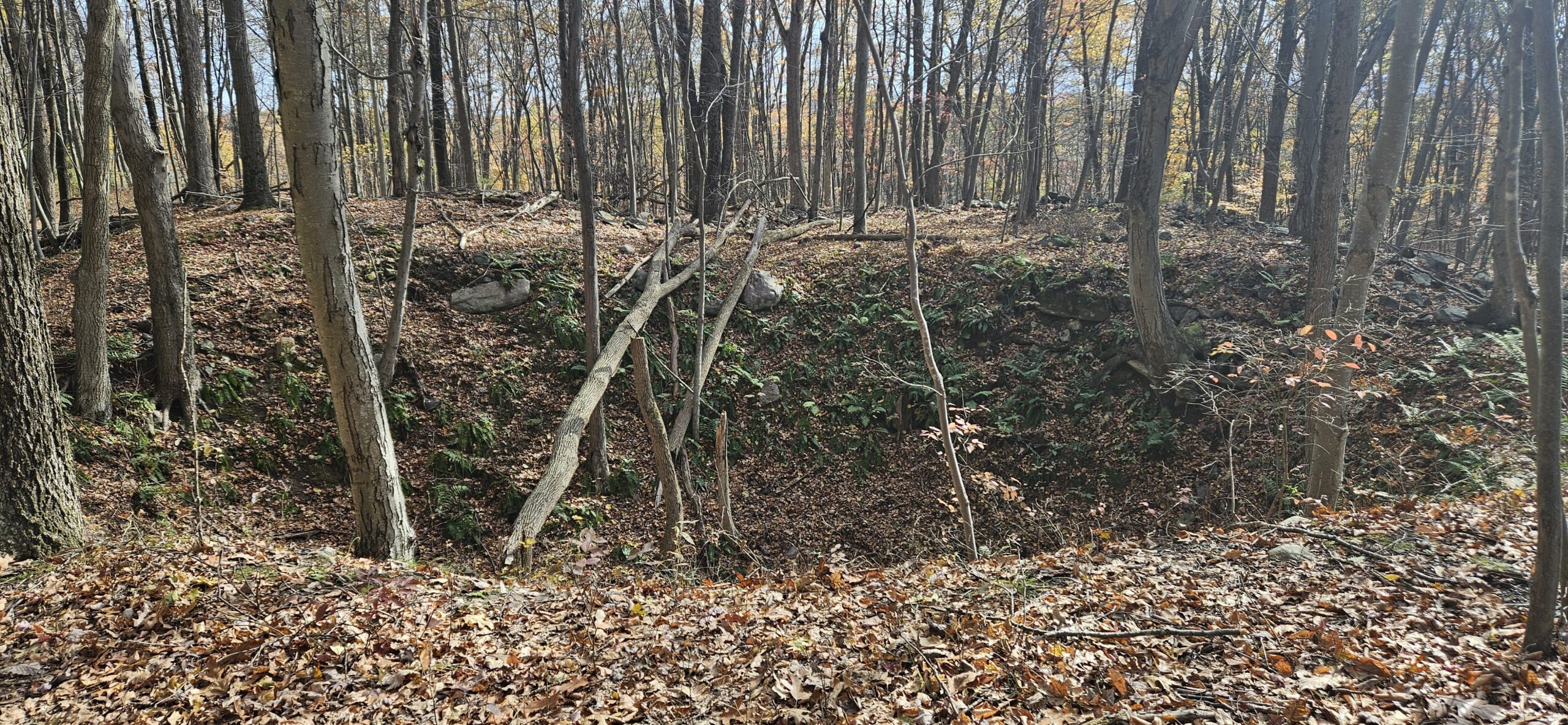
Located a few minutes from the busy Interstate 80 and Rockaway Townsquare Mall is the often-overlooked Mount Hope Historical Park. The land this park sits on was once home to multiple mining operations for about 270 years. While the mining operations have ended, the effects of these activities are still evident today in the form of subsidence pits, or sinkholes caused by collapsing tunnels. Continue reading to learn more about this little-known park in Morris County.
Explore North Jersey Review: Decent and quiet hike in a landscape scarred by mining
Background
Mount Hope Mining
The park features the remains of three mining complexes: the Teabo, Allen, and Richard Mines. Along the White Trail, but outside park property, visitors also pass near the sites of the New Leonard Mining Complex and the Elizabeth Mine. The New Leonard Complex is largely hidden by forest growth and is on private property, though. Mining activity in what is now the park began as early as 1710 and continued until 1978. However, large-scale operations slowed down significantly during the Great Depression.
Mount Hope lies within the New Jersey Highlands, a rugged, mineral-rich region of the state. During the 18th and 19th centuries, Morris County was one of the busiest mining areas in the state and country. Miners excavated iron ore, which was rocks such as magnetite from which iron was extracted. Today, while limited forms of mining persist elsewhere in New Jersey, iron mining has ended.
Route 80 Sinkholes
On December 26, 2024, a sinkhole appeared on the eastbound lanes of the nearby Interstate 80. The highway was repaired and reopened in a few days. On February 10, 2025, another sinkhole appeared near the first, closing the highway once again. During the repairs on March 19, 2025, yet another sinkhole appeared, this time closing the westbound lanes as well as the eastbound lanes. Over the next few months, there were staggered lane reopenings as repairs were made, but the highway did not fully reopen until June 21.
While the sinkholes were not caused by the mines in Mount Hope itself (those are about a mile away), they were caused by other nearby and extremely similar mining operations, more specifically, the Huff and Mount Pleasant Mines. As described above, this area of New Jersey was once covered in mines, and has been compared to “Swiss Cheese” due to all the holes in the ground.
While you hike around Mount Hope Historical Park, you will see many depressions in the ground known as subsidence pits. Most of these are actually sinkholes caused by the collapse of underground tunnels, similar to what happened on Route 80.
The Hike
Mount Hope Historical Park features two main loops from the parking area. To the north (right) is the White Loop, and to the south (left) is the Red and Orange Loop. As the loops both start and end at the parking area and do not intersect, the two loops are described separately below. The Red and Orange Loop is longer, but the White Loop is slightly more challenging and features the most impressive mining remains.
The park map features 10 numbered locations, each with a short description on the trail map. Trail maps are not provided, so you will need to print your own or look at your phone while hiking. The White Trail features numbers 1-3, and the Red and Orange Trails feature 4-10. When I visited, I chose to visit the locations in numerical order, but that is not necessary. I actually find it more intuitive to follow the numbers out of order when following the Red and Orange Trails.
White Loop
The White Trail passes the remains of the Elizabeth and Teabo Mines and climbs a small, unnamed hill. While shorter than the Red and Orange Trail loop, the White Trail is slightly more challenging.
Distance: 1.3 miles
Ascent: ~320 feet
Difficulty: Easy-Moderate
The trail begins at the main parking area on Teabo Road. From the parking area, you will see two trails, one in the middle of the parking area and one near the directory. It does not matter which you take, as they merge almost immediately after climbing the short hill to a set of powerlines. At the powerlines, you will see a signed intersection for the Red Trail and White Trail split. Turn right to begin the White Trail.
The sign for the White Trail incorrectly lists the distance as 0.5 miles. In reality, it is about 1.3 miles. The back section of the trail is on town property. It appears that the Morris County Park Commission only listed the section of the trail directly in Mount Hope Historical Park when making the sign. I think this is misleading, as there is no sign or indication when you cross property lines, and it is impossible to do the trail in 0.5 miles without turning around early.
As the trail is a loop, you will quickly be given the option to turn left or right. I recommend turning right to end the hike with the more interesting mining remains.
You will quickly reach signposts 1 and 2. Unfortunately, you cannot see anything at these sites. Continue on the trail for about a half mile as the trail follows a powerline cut. You will soon reach a fork where the White Trail turns left. Walk across the powerlines, and make another left to remain on the White Trail.
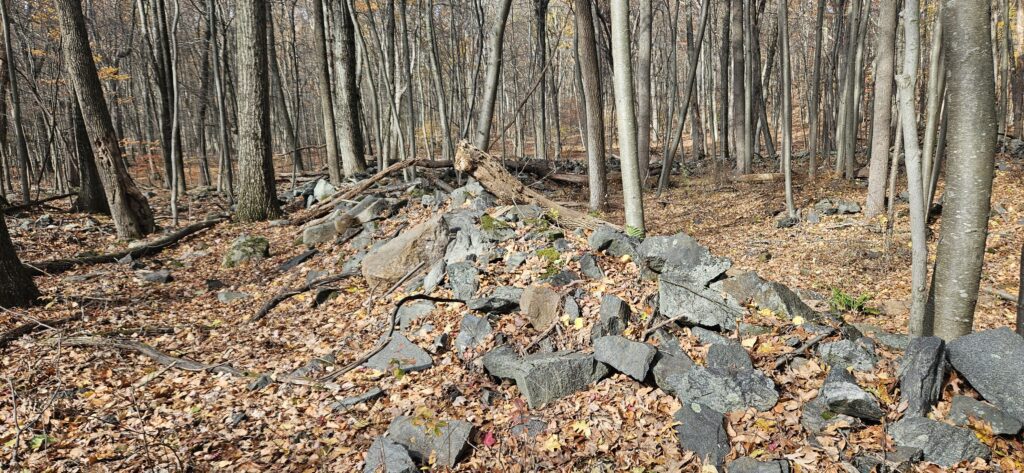
Here you will start to see the first signs of mining activity, with many subsidence pits (sinkholes caused by collapsed mines), excavated areas, and mine tailings (unused waste rock). From this point forward, you will see various pits and tailings until you finish the loop. In a few hundred feet, you will reach another intersection. You will see markings for the White Trail to both the left and straight ahead. The main loop is to the left. The other White Trail ahead dead-ends at the Picatinny Arsenal property in a short distance.
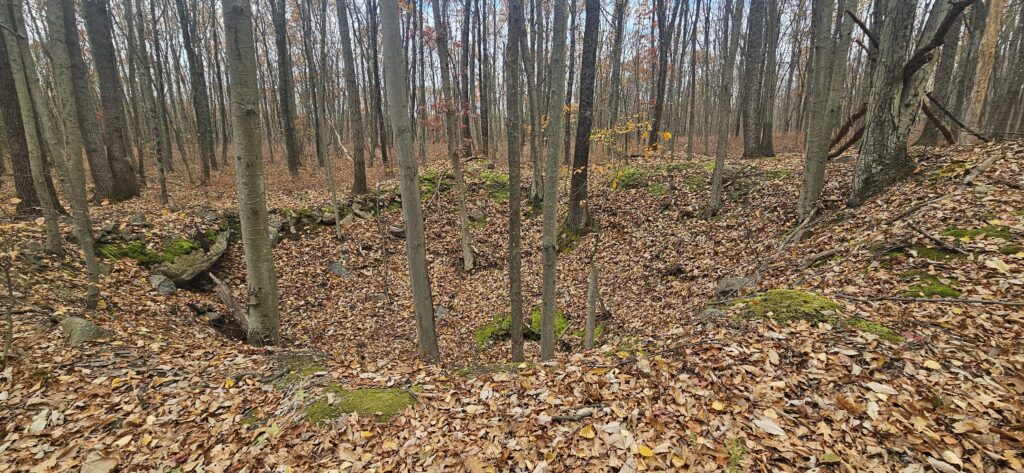
After turning left, you will begin a moderate climb to the top of an unnamed hill. About halfway up the hill is the most impressive hole: The Elizabeth Hoisting Shaft. This shaft was used to excavate ore (rock with valuable minerals) and is almost impossible to miss as it is surrounded by a set of two barbed wire fences. Due to the fencing, it is somewhat hard to see, and pictures do not do it justice, but this shaft is massive.
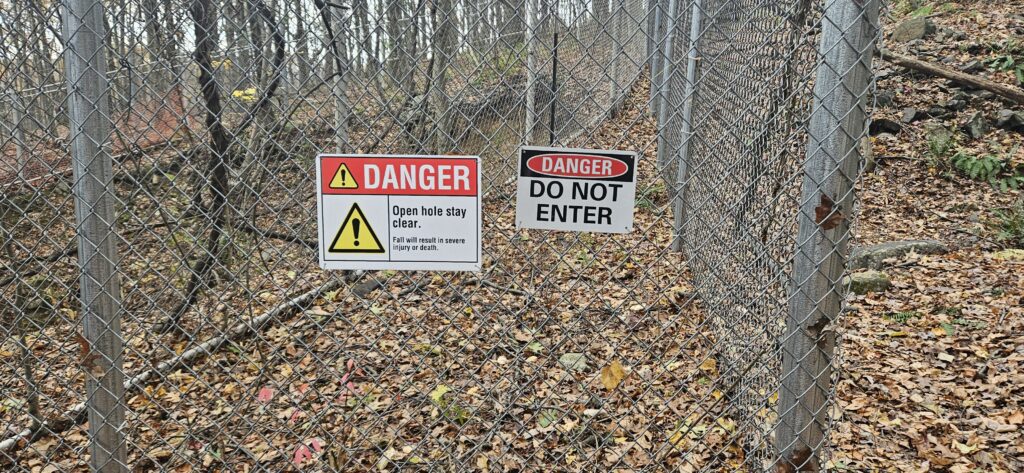
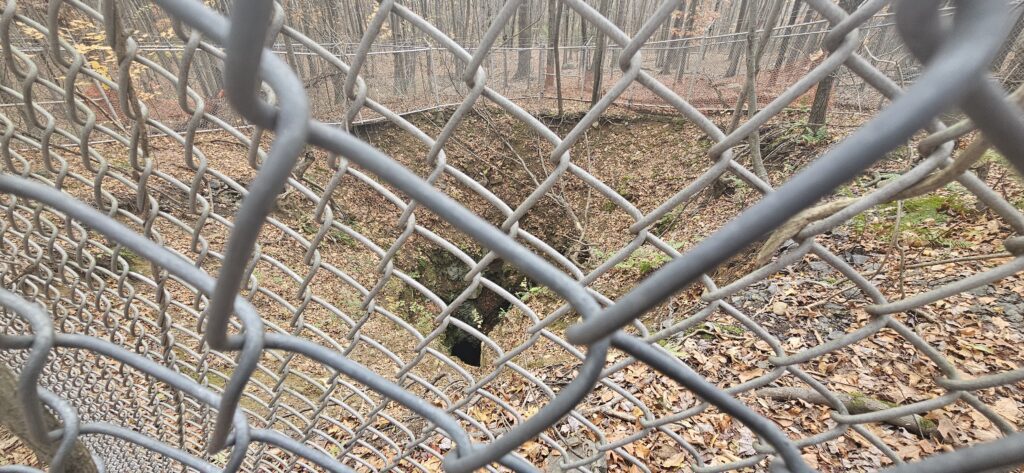
From the Elizabeth Hoisting Shaft, continue up to the top of the unnamed hill. Here you will find many large subsidence pits from the Elizabeth and Teabo Mines. The subsidence pits mark the path of the iron vein and follow a straight line northeast to southwest. The trail then begins to work its way downhill, weaving around many of these large pits.
You will soon reach the end of the White Trail, where you can continue onto the Red and Orange Loop or return to your car.
Red and Orange Loop
The Red and Orange Loop is a combination of trails: the Red and Orange. Those looking for a shorter trail can just take the Red Trail. The Red and Orange Loop is longer than the White Loop and passes by part of the Teabo Mine as well as the Allen Mine and the Richard Mine.
Distance: 2.6 miles
Ascent: ~300 feet
Difficulty: Easy
The trail begins at the main parking area on Teabo Road. From the parking area, you will see two trails, one in the middle of the parking area and one near the directory. It does not matter which you take, as they merge almost immediately after climbing the short hill to a set of powerlines. At the powerlines, you will see a signed intersection for the Red Trail and White Trail split. Turn left to begin the Red Trail.
The trail begins in a flat area, before climbing up a small hill. At the top of the hill, you will see many piles of mine tailings and then many large subsidence pits. The first part of this hike has the highest frequency of these pits in the park. Soon you will reach a fork where the Red Trail splits. I recommend continuing straight.
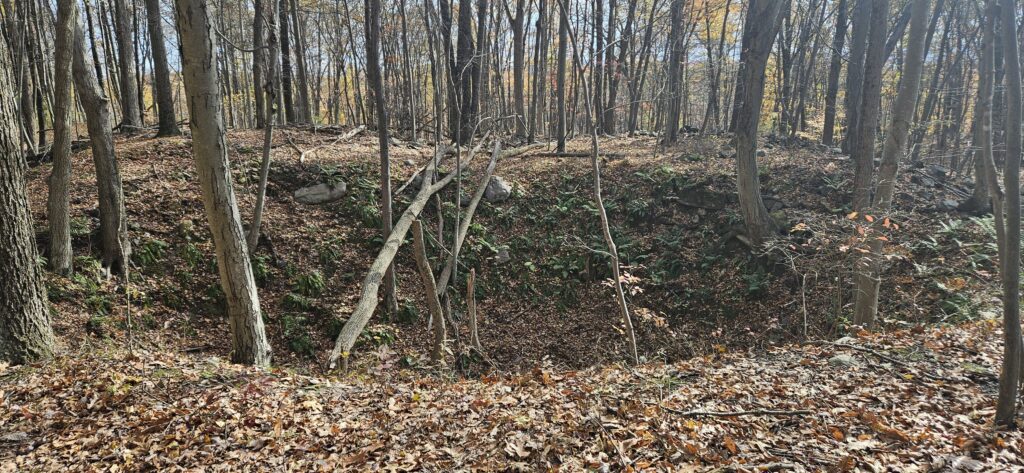
After the fork, you will reach the largest subsidence pit in the park at the site of the old Allen Mine. Near this pit, and labeled on the park map, are the ruins of the Allen Tunnel. According to the description on the map, the ruins of the tunnel are visible from Teabo Road. I was unable to find the tunnel while exploring both off-trail and by driving along Teabo Road, but I was able to follow a path of subsidence pits to the area of Teabo Road. As evidenced by the presence of the pits, most of the tunnel has collapsed.
Continue straight. The Red Trail soon turns left, and the Orange Trail begins ahead. I recommend beginning the Orange Trail here, as it is more intuitive when you hike it. This would mean that you follow the numbered markings out of order, but I personally do not think the numbers add much to the hike.
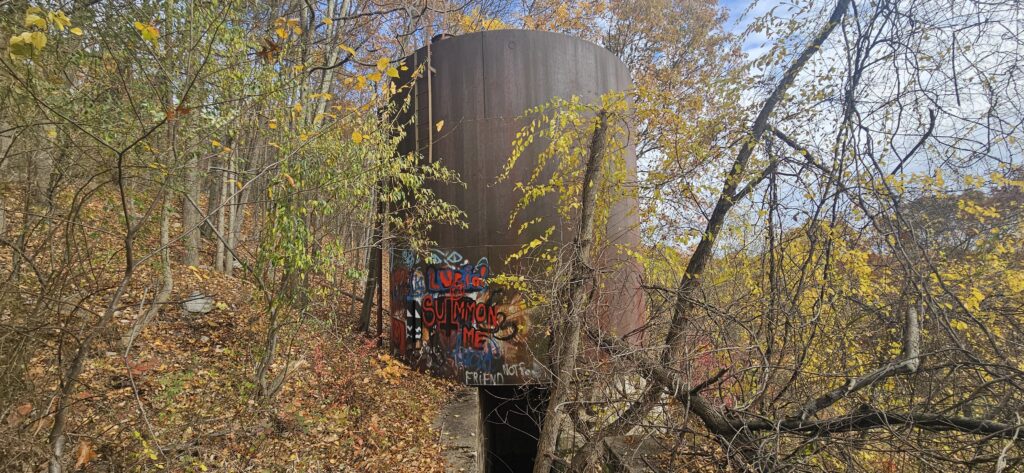
If you continue straight on Orange, you will pass by a few more subsidence pits, and the trail will begin to work downhill. To the left, just before reaching the powerlines again, you will reach the ruins of a pair of water towers. Only one tower remains, but the foundation of the removed tower is still present.
The trail then passes under the powerlines and passes the ruins of a few buildings. These ruins are mostly removed, with only small hints of their foundations remaining. The trail quickly crosses under the powerlines again and begins to work its way uphill. From this point on, you are hiking away from the iron vein, and as such, there are very limited signs of the mining history.
You will soon reach the Green Trail on the right. This is a shortcut for a small portion of the Orange Trail. It is slightly steeper, but not challenging. Whichever option you choose, you will end up at the same point in a short distance.
From here, simply continue on the Orange Trail until it ends at the Red Trail. At the Red Trail, turn left to complete the trail, which ends at the fork encountered earlier. From there, walk back to the parking area.
GPS Route
Attached is the route as described above for reference. Additionally users can download the route to use on their preferred GPS. How to use the GPS routes on your phone.
Review
Mount Hope Historical County Park is decent, but not as interesting as the map would lead you to believe. While the map features a ten-stop guided tour, most of the described points have very little to show. It is also annoying to read about these points, as Morris County no longer leaves paper trail maps at the directory, and the numbered points have no additional information without consulting the map. The park is best for those looking for a relatively easy hike on well-maintained trails, or for those interested in mining history.
Additional Information
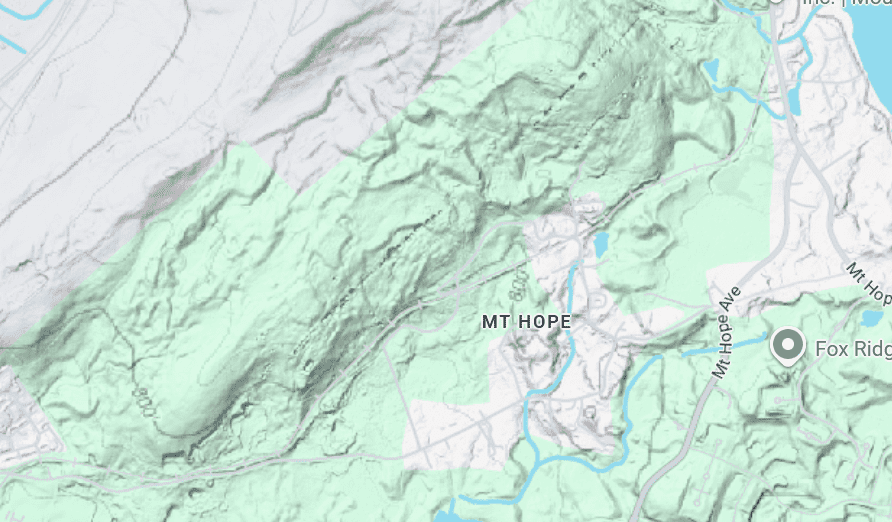
- The subsidence pits seen on the hike are so large and so frequent, that they are actually clearly visible on a topographic map created by satellites. Below is screenshot of the terrain map on Google Maps. The straight dotted line extending from the bottom left (southwest) to the top right (northeast) are the subsidence pits and location of the mining.
- Near Mount Hope (and also in Rockaway) are the Hibernia and Beech Mines at Wildcat Ridge Wildlife Management Area which can be hiked to as well.
- It is a coincidence that the name Rockaway sounds like it came from the town’s mining history (rock-away). Rockaway Township is actually named after the Native American word “Rechouwakie” which means “the place of sand.”
Leave a Reply